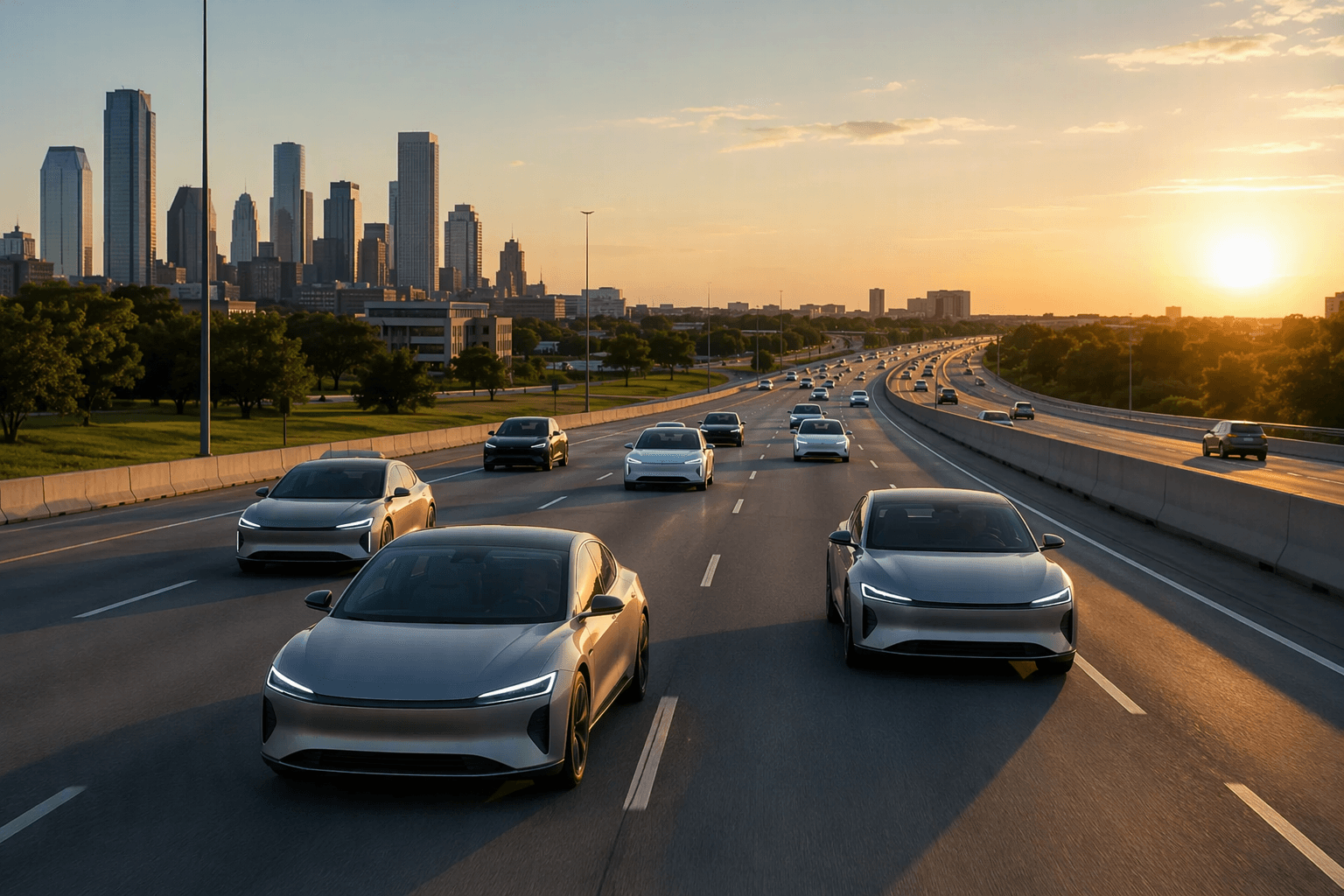
A recent study led by Khaled Abdelghany from Southern Methodist University has revealed that fully autonomous vehicles could potentially reduce traffic delays across the Dallas-Fort Worth area by up to 33 percent, without the need for new highway lanes. This research was conducted in collaboration with the Texas A&M Transportation Institute and received partial funding from the region's council of governments.
The study involved 25 experiments that modeled traffic conditions in 2045, examining scenarios with varying levels of autonomous vehicle adoption: 100 percent, 50 percent, and 25 percent. In the scenario with full automation, researchers found that delays could decrease by as much as 33 percent, while time spent in congested traffic could drop by at least 19 percent.
The rationale behind these findings is based on the behavior of human drivers, who often create phantom traffic jams through inconsistent braking and spacing. Khaled Abdelghany noted that autonomous vehicles could alleviate these issues by promoting smoother and more coordinated driving.
Currently, Texas is at the forefront of testing and deploying driverless freight. Aurora Innovation has initiated commercial driverless deliveries between Dallas and Houston since late April 2025, marking the first such service in the United States. These trucks operate along the I-45 corridor, which is a significant route for truck freight in Texas, transporting various goods without human drivers onboard.
In addition to Aurora, other companies such as Kodiak Robotics, Waymo Via, and Gatik are also involved in developing autonomous trucking in Texas, solidifying the state’s position as a leader in this emerging industry.
On the passenger side, Waymo has been operating a paid robotaxi service in Austin and has expanded its services to select riders in Dallas, Houston, and San Antonio, with plans for broader availability.
While the study presents promising projections for the impact of autonomous vehicles, it is important to note that the job landscape will evolve rather than diminish. The industry will still require technicians, remote operators, and support staff for maintenance and monitoring, indicating a shift in job roles rather than a loss.
The study's headline figure of a 33 percent reduction in traffic delays applies to a scenario where all vehicles are autonomous, which is not expected to occur in the near future. The research also highlights potential challenges, including the possibility of increased empty vehicle miles and the effect on public transit ridership.